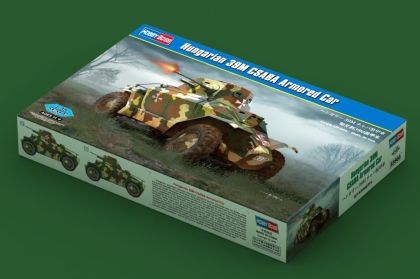
Hungarian expatriate Nicholas Straussler designed several armoured cars for Britainwhile living there between the two world wars. Straussler came to an agreement with the Weiss Manfred factory of Csepel, Budapest to produce vehicles from his designs for use in his home country - the most prominent was the Csaba (named after the son of Attila the Hun) which was designed based on his experience of the Alvis AC2 armoured car.After successful trials in 1939, the Hungarian Army placed an order for 61, and a further order for an additional 40 vehicles was placed in 1940. Of these, twenty were used as actual fighting vehicles, with the remainder serving as armoured command cars and reconnaissance vehicles.The Csaba had a 20mm cannon and an 8mm machine gun fixed on a centrally mounted turret, with 9mm armoured plating. The vehicle was also equipped with a detachable 8mm light machine gun fired through the rear hatch in the anti-aircraft role. The crew could dismou
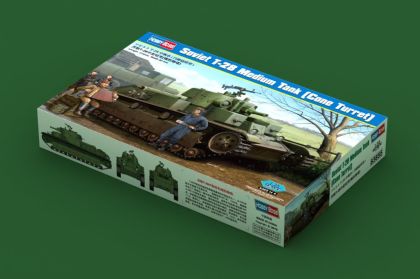
The Soviet T-28 was among the world's first medium tanks. The prototype was completed in 1931 and production began in late 1932. It was an infantry-support tank intended to break through fortified defences. The T-28 was designed to complement the heavier T-35, with which it shared many components. The type would not have that much success in combat, but it played an important role as a development project for the Soviet designers. A series of new ideas and solutions were tried out on the T-28 and were later incorporated in future models.
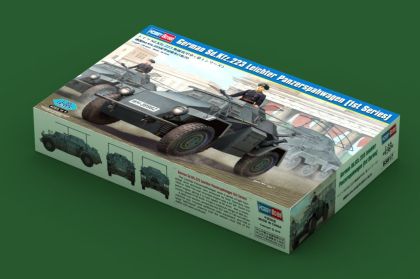
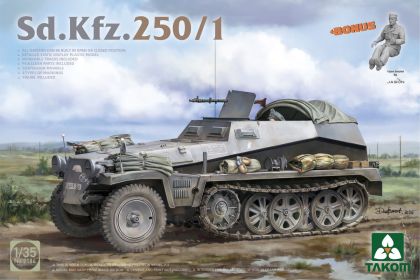
The Leichter Panzerspähwagen were a series of light four-wheel drive armoured cars produced by Nazi Germany from 1935 to 1944.The rear mounted engine was a 67 kW Horch 3.5 petrol engine, giving it a road speed of 80 km/h and a cross-country speed of 40 km/h. It had a maximum range of 300 km.
A radio car version, armed like the 221 with a 7.92 mm MG34 machine gun. Included additional radio equipment, and had a large "bed-frame" antenna over the vehicle. Over 500 of the SdKfz 223 were produced.
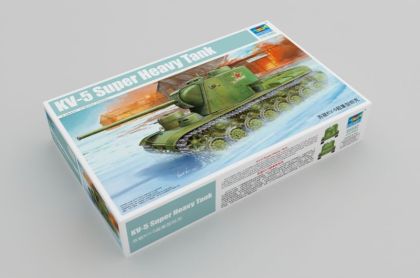
KV-5 (Object 225) - A cancelled project for a super-heavy tank. Armament was to be a 107 mm ZiS-6 gun in a large turret and machine-gun in a small secondary turret. Weight was projected as about 100 tons, and the tank was to have 150-180mm of armor. Project development began in June 1941, however was cancelled due to the Siege of Leningrad, in which all developmental operations at the Kirov Plant were halted. The project fell out of favour from the more advanced heavy tank designs, and no prototype was built.
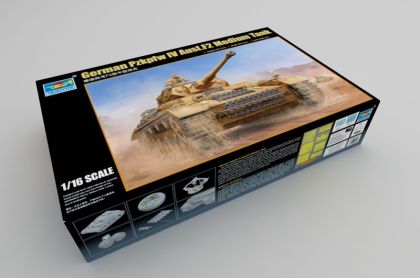
The Panzerkampfwagen IV (Pz.Kpfw. IV) Sd Kfz 161, commonly known as the Panzer IV, was a medium tank developed in Nazi Germany in the late 1930s and used extensively during the Second World War. Its ordnance inventory designation was Sd.Kfz. 161.
Designed as an infantry-support tank, the Panzer IV was not originally intended to engage enemy armour—that function was performed by the lighter Panzer III. However, with the flaws of pre-war doctrine becoming apparent, and in the face of Soviet T-34 tanks, the Panzer IV soon assumed the tank-fighting role of its increasingly obsolete cousin. The most widely manufactured and deployed German tank of the Second World War, the Panzer IV was used as the base for many other fighting vehicles, including the Sturmgeschütz IV tank destroyer, the Wirbelwind self-propelled anti-aircraft weapon, and the Brummbär self-propelled gun, amongst others.
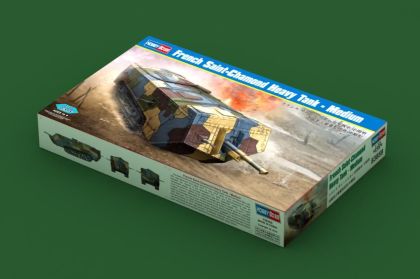
The Saint-Chamond was the second French heavy tank of the First World War, with 400 manufactured from April 1917 to July 1918. Born of the commercial rivalry between the makers of the Schneider CA1 tank, the Saint-Chamond was an inadequate design. Its principal weakness was the "caterpillar" tracks . They were much too short in relation to the vehicle's length and heavy weight ( 23 tons ). Later models, however, attempted to rectify some of the tank's original flaws by installing wider and stronger track shoes, thicker frontal armor and the more effective 75mm Mle 1897 field gun. The Saint-Chamond tanks remained engaged in various actions until the late summer of 1918, belatedly becoming more effective after combat had moved out of the trenches onto open ground . Eventually, however, the Saint-Chamond tanks were scheduled to be entirely replaced by imported British heavy tanks.
Sobald das Produkt wieder auf Lager ist, bieten wir es Ihnen bevorzugt an – Sie werden per E-Mail informiert und haben eine begrenzte Zeit für den Kauf.
Mit Ihrer Zustimmung können wir die folgenden Informationen für die nachstehend beschriebenen Zwecke nutzen oder an ausgewählte Partner weitergeben. Für jeden Zweck (Art der Verarbeitung) können Sie Ihre Einstellungen anpassen und Ihre Auswahl mit der Schaltfläche "Einstellungen speichern" bestätigen:
Immer aktiv
Erforderliche Cookies
Dies sind technische Dateien, die für das ordnungsgemäße Funktionieren unserer Websites und all ihrer Funktionen erforderlich sind. Sie werden unter anderem zum Speichern von Produkten im Warenkorb, zum Anzeigen von Produkten auf der Wunschliste, zur Steuerung von Filtern, zu persönlichen Einstellungen und auch zur Verwaltung der Cookie-Zustimmung verwendet. Für diese Cookies ist Ihre Zustimmung nicht erforderlich und kann auch nicht entzogen werden.
Analyse-Cookies
Sie zählen die Website-Besuche und ermöglichen durch die Erfassung anonymer Statistiken dem Betreiber, seine Besucher besser zu verstehen und die Seiten ständig zu verbessern.
Marketing-Cookies
Sie sammeln Informationen zur besseren Anpassung der Werbung an Ihre Interessen, sowohl auf dieser Website als auch außerhalb.
Um Ihnen das Navigieren auf der Website zu erleichtern, Ihnen personalisierte Inhalte und Werbung anzubieten und die Besuche anonym zu analysieren, verwenden wir Cookies, die wir mit unseren Partnern für soziale Medien, Werbung und Analyse teilen. Sie können diese Einstellungen über den Link "Einstellungen ändern" anpassen und jederzeit in der Fußzeile der Website ändern. Weitere Informationen finden Sie in unseren Datenschutzrichtlinien und Cookie-Richtlinien.